
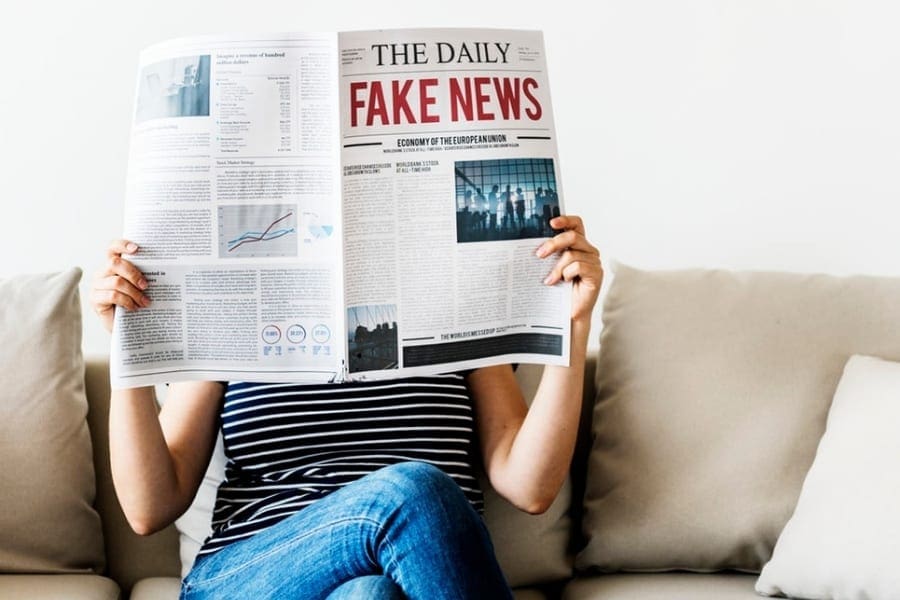
Digital platforms are what drives all businesses today, except for maybe the corner café.
It has unleashed innovative practices that enable greater global reach but, instead of only positive news, sharing and brand building, hoaxes and disinformation referred to as fake news is accelerating and seriously affecting how people interpret what they read online.
Where Does Fake News Originate
Driven by billions of websites with foreign participants, individual blogging and the proliferation of cable and radio news, many information sites have become contentious and polarized with a decline in public trust in what they read online. Sophisticated disinformation and fake news are often difficult to spot and there is a growing concern in how to address the issue without completely undermining digital media and its benefits.
The major issue is not to omit reading what is online since that is what brought you here too. For example, let's say you are interested in starting a new business, like a mobile boutique; when you get misinformation regarding trade associations, rules and regulations, you might be heading for big trouble. After all, the idea would be to get as much valuable and factually correct information before you head into a big new venture. The same goes for treating your baby at home using holistic medicine etc., where the advice would be to only follow reputable sources like WebMD in non-emergency cases.
How To Proceed In Finding Facts
Busy individuals that only relax late at night, while on the train or bus home and want to play favourite online games need to know it is regulated, secure and fully licensed. Conglomerated information on Trustpilot for sites like Mr Green casino allows you to gain insight on the company but it’s also equally important to go directly to the source site in order to verify the legitimacy of the information. It is easy to take for granted that the company works with reputable software creators Playtech, Net Entertainment, Evolution and the like but, often, the proof lies in finding further proof of credibility. Reviews are a great way to ensure that what you want to know about a company is true as proven by those who’ve used it.
Harvard University gives its opinion on spotting fake news which includes vetting the credibility of the publisher to verify if they meet the academic citation standards. Look at the domain name and always be wary of URLs like.com.co which is unusual and illegitimate simply because it carries a second-level domain and yet is very similar to the usual .com domain. Who is the author of the publication, can you find anything else that he or she has written and is the contact email address a Gmail account? Do you notice any dramatic punctuation like 1?1?1, ALL CAPS, and spelling errors? If you do, abort the reading mission.
Is It A Reputable Source?
Articles that should be fed by fact-gathering must have credible sources that will indicate its authenticity. Check the links within an article or website and see what kinds of backlinking and inbound linking are done. The Harvard Library is an excellent resource to use for checking public resources with a massive database that could confirm the information's credibility.
If you want to verify specific information that is fact-based and research-driven, try using a fact-checking website when you have time to spare. Some good ones include the Poynter Fact Checking and Factcheck.org.



0 Comments