
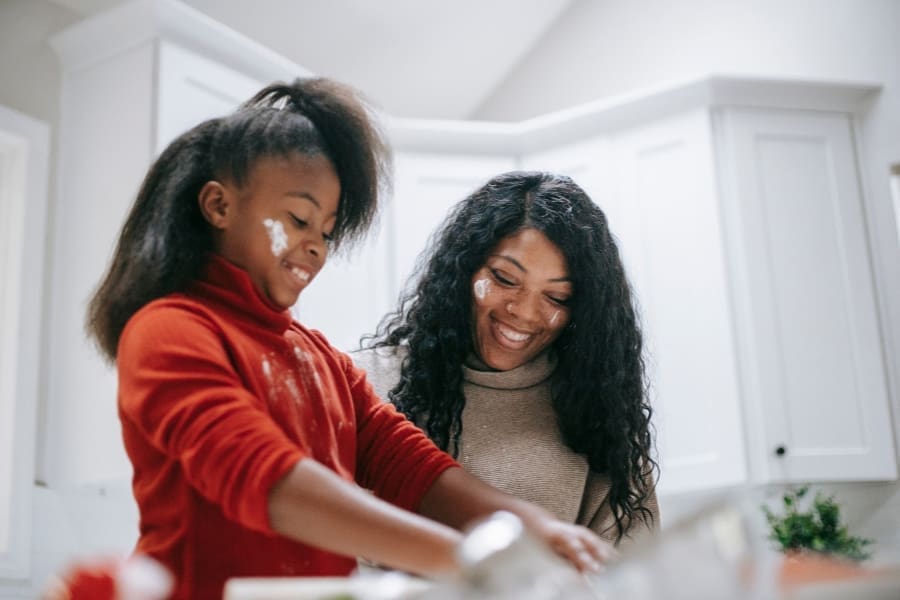
Growing up, you’ve probably learned to associate your kitchen with more than a mere cooking space made for eating, cleaning, and other basic tasks.
More often than not, this room is where guests are welcomed to enjoy dinner or cocktails, children do their homework while supervised by their working parents, and other interaction-based activities are conducted. This is also among the main spaces in the home that children heartwarmingly remember as they progress to adulthood and beyond, often crossed by smells and visuals that trigger childhood memories.
Evidently, things haven’t changed that much, especially when you’re a working mom and full-time employed parent looking to make the best in both worlds. Time runs faster for you than for stay-at-home parents, meaning you must learn how to kill two birds with one stone. This is where you’re invited to take your children into your kitchen when you cook, clean, hang around, and so on, assured that they’ll learn the essentials that will develop them into self-sufficient, confident, and resourceful people. Don’t worry about them making a great deal of mess, for solutions are endless. In the worst-case scenario, some furniture units could deteriorate or discolour. Fortunately, should that be the case, you have a wide variety of first-rate replacement kitchen doors that can be easily installed and give a new face to your kitchen on a budget.
So, how exactly will spending time in the kitchen nurture your child's healthy mental, physical, and spiritual growth? We’ll discover this in the lowdown below!

Photo source: https://unsplash.com/photos/a-woman-and-a-child-sitting-at-a-kitchen-table-BdHthauUxlQ
The needed confidence and self-esteem
Too much self-esteem and confidence can lead to arrogance, whereas too little of it is the key to an insecure, self-loathing adult. Striking a balance may feel daunting since you bear the more significant responsibility of how they’ll grow in this regard. Nevertheless, remember that the more time you spend with them and approach them with the correct behaviour, the higher your chances of seeing your kid transform into the extreme you don’t want them to be.
Cooking with children suggests you trust they can handle challenging tasks as starters. It offers you the occasion to teach them not to be stubborn, to accept help, and to review every piece of information coming their way to build a healthy reasoning system.
Caregivers may continue promoting self-esteem, confidence, and a sense of accomplishment when resorting to approaches like the following:
- Put your child in the know about what you’re trying to achieve together from the beginning, discussing rules and responsibilities.
- Approach recipes that your child can easily understand, such as pancakes, soups, omelettes, gratin vegetables, and so on.
- Allow them to select their favourite meal from a variety of recipes, essential ingredients, flavours, cuisines, and so on.
Improved set of executive function skills
Executive functioning, together with self-regulation, depends on three brain functions: self-control, mental adjustability, and working memory. These skills are essential for your child’s healthy development into a resourceful adult, encouraging flexible thinking that will help them find solutions to difficult situations instead of giving up easily.
Executive functioning skills contribute to problem-solving, attention, organizing, planning, and impulse-controlling actions, assisting your sweet bundle of joy in taking control over their behaviour. Just like plenty of other masteries, this skill is best appropriated within their developmental stages. Your kitchen is a great place to nurture their executive functioning skill growth.
Cooking, for instance, will help them learn the art of impulse control. Getting something mouth-watering out of the oven could tempt them to erratically grab and taste a piece, risking burns. Teaching them to think of the consequences before touching the heated deliciousness will pave the foundation for building their control over impulses, patience, and responsibility.
Other ways to further this set of skills are by curating grocery lists together, following recipes, sharing tasks, gathering equipment, and explaining the chemistry behind ingredient mixtures, to name a few.
Learning to socialize and bond
A child’s relationship with their parent during their infancy is the basis of what they’ll reap later, setting the stage for adulthood interactions. Teaching them how to create connections becomes essential during this period. Through their early connections, they’ll understand they’re worthy of care, love, and support, namely the foundation of self-esteem. Moreover, you’ll lay the groundwork for learning the importance of protecting and feeling secure. From this base, they can navigate and bond with children and people outside their family circles.
Cooking connects and promotes social skill progress through a mutual sense of belonging, opportunities to laugh together and observe each other’s behaviour, sharing joint interests, and so on. Spending time together carrying out such pleasant activities will instil in your child the conviction that they’re worthy of time and can learn to do anything they put their mind to.
Here’s a simple yet valuable example. Preparing meals together will encourage your little learner to choose a recipe, practice communicating and listening, and learn how to reason. These foster the traits that will have them playing, communicating, working, and collaborating with others, setting the foundation for an adjustable and cooperative pupil in school and beyond.
Improved fine motor skills
From how your child uses their wrist, hand, and fingers to the meticulousness of their movements, all these activities fall under the category of fine motor skills. They learn these abilities all throughout their early childhood, precision being always a good thing to perfect. This journey goes on well into their grown-up period.
Cooking is great for boosting these capacities as they’ll need exactness to work with utensils, fragile items, ingredients, and so on. Practising this dexterity can take many forms, like having them pick up small and delicate objects, mix batter, smash potatoes, pour sugar powder, and so on.
Curiosity but a lot of unearthed power are to be discovered by you after introducing your child to the fabulous world of cooking. May your kitchen serve as the perfect set to promote their healthy development!



0 Comments